


At the “Investment Outlook” (Raízes do Investimento) event held on July 8, Hexing Livoltek Brazil, BYD Battery Industry Co., Ltd., Granja São Pedro, and Amazônia Pneus highlighted innovative solutions for sustainable development in the Amazon region. These solutions include electric outboard motors, solar cells, more efficient egg and milk production methods, and the strengthening of the natural rubber industrial chain.
Márcio Sousa, Industrial Manager at Livoltek, introduced the company’s latest innovation: an electric outboard motor, which is scheduled to enter production at the Manaus Industrial Pole (PIM) in 2026. The manager explained that this innovative technology is specifically designed for riverside communities, aiming to reduce river pollution and combustion emissions currently caused by conventional outboard motors, which typically run on gasoline or diesel.
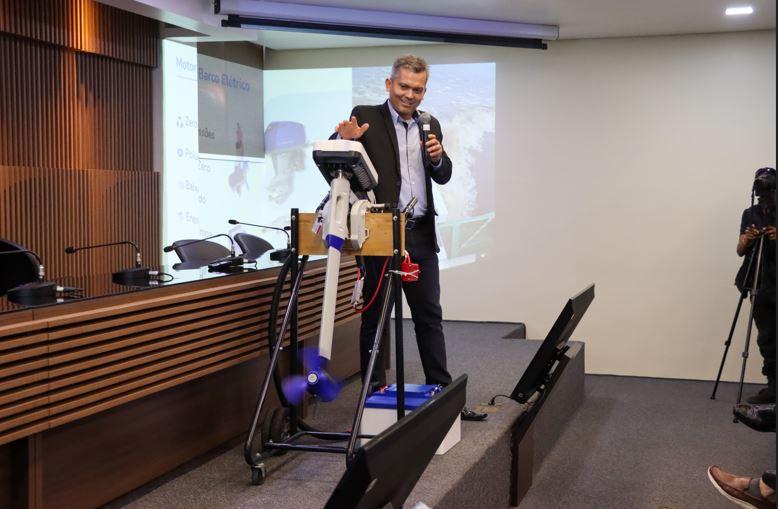
“The device I am demonstrating today can be mounted on the canoes of riverside communities,” he stated. “Our batteries offer an approximate runtime of four hours. Given the unique environment of the Amazon region, we have designed a vertical outboard motor. Furthermore, considering factors such as low-tide seasons and the need to monitor changing river conditions, we have also developed a horizontal outboard motor.”
Sousa emphasized that Livoltek’s operations in the Manaus Free Trade Zone (ZFM) are already inherently innovative. “Livoltek manufactures batteries for our inverters. During the production process, we receive direct current (DC) loads and convert them into alternating current (AC), which then requires a battery to manage that load. Consequently, we have invested 28 billion Reais in chargers, and by the way, our production pipeline has only just begun,” he stated.
The industrial manager stated that the company is expanding and plans to deploy new projects. “We have already planned to recruit approximately 93 employees to handle training, certification, and charger production. This presents us with a rare and valuable opportunity,” he said.
BYD representative Kleber Costa also emphasized the importance of changing certain standards to create a more sustainable world. Regarding electric vehicle (EV) production, he explained that PIM is currently part of a larger process for the company.
He explained: “The battery modules are assembled in the ZFM. We receive the raw cells from China and assemble a set of cells here, which we call a battery module. Once the battery module is completed, we send it to our client—in this case, our designated client, BYD in Campinas. There, it is installed onto the bus chassis, goes through the final assembly and finishing, and is then delivered to the municipalities and clients who ordered the vehicles.”
When asked if BYD plans to expand its production scope beyond battery modules, Costa stated that this is one of the company’s goals for next year.
“Yes, absolutely. We have a new ‘Blade’ battery project,” he stated. “As mentioned in the demonstration, this battery represents the active technology currently used in electric vehicles, and BYD is now applying for approval from the National Department of Transport Infrastructure (DNIT) and regulatory agencies to implement this new technology in these electric buses. Therefore, by 2026, we will certainly implement and deploy new projects within the Amazon region’s Free Trade Zone.”
In the livestock sector, Granja São Pedro introduced more eco-friendly sustainable production processes and stricter animal care regulations. The company showcased innovations in the production of dairy products, including cheese and milk. CEO Francisco Peixoto emphasized: “The pursuit of quality is one of the most important aspects.”
Drop in Production
Auro Levorin, project coordinator for the tire industry, reported that rubber production in the Amazon region has declined in recent years, but the goal is to resume growth and generate income for the region’s extractivist families.
“Before the pandemic outbreak, rubber production in the free trade zone dropped sharply. Last year, our output was less than a third of what it used to be. In 2015, we produced 1,600 tons of rubber, benefiting 2,300 families in the Amazon region. Amazônia Pneus aims to restore rubber extraction in the Amazon,” he said.
Levorin emphasized that they are working with the federal and state governments to develop projects aimed at ensuring the rubber supply chain reaches a production capacity of 2,400 tons.
“Once we reach full production capacity, this 2,400 tons of rubber will be driven entirely by Amazônia Pneus’s output. In doing so, we will benefit 4,000 families in the Amazon. We will purchase all the rubber produced, guaranteeing these families a substantial income and thereby helping to protect the forest,” he added.
More Projects
According to data from Sedecti and the Amazonas Development Council (Codam), 565 new companies were established in the Manaus Industrial Center between 2019 and June 2025, creating 23,224 new jobs with total investments reaching 12.8 billion reais.
According to partial data from PIM performance indicators, in 2024 alone, the sectors that received the most investment were: electronics (2.99 billion reais), thermoplastics (1.97 billion reais), chemicals (1.33 billion reais), and two-wheelers (1.2 billion reais).
Gustavo Igrejas, executive secretary, emphasized that the event is an opportunity to present, in an educational manner, the resolutions approved during the Amazonas Development Council (Codam) meetings.
“We have noticed a certain lack of understanding in our society regarding the operations of the Manaus Free Trade Zone,” he emphasized. “Therefore, the goal of this event is to present these data, showcasing not only what is produced here, but also how it is produced. The Manaus Industrial Center generates significant value-add for us, and this needs to be made public.”
Igrejas also stated that the tax reform has brought greater security for new investments and spurred growth in several sectors.
“So far, I haven’t seen any negative impact from the tax reform that would hold back major investments here. Quite the contrary. Over the next five to six years, sectors like IT and plastics will likely be far more attractive for manufacturing than the rest of the country,” he noted.